Two Different Priorities
The EcoTank and the PIXMA PRO-200 both come up constantly in proxy printing because they're both capable printers built for completely different priorities. The EcoTank is engineered around running cost. The PRO-200 is engineered around output quality. The right choice depends on your volume, your cardstock, and how much the output matters to you.
The EcoTank Case
The EcoTank innovation is the refillable tank. Instead of $30 to $40 cartridge sets that run out every 100 pages, you fill from ink bottles that last for hundreds of pages. For proxy printing (full-bleed, photo-quality output at scale), this changes the economics.
The Epson EcoTank ET-2850 is the entry point. 4-color CMYK tank printer. Solid color reproduction, clean dark art, and per-page cost low enough that printing a Commander deck runs roughly $0.25 in ink. The ceiling is stock thickness: the ET-2850 tops out reliably around 200 gsm. Push past that and you'll see misfeeds.
The Epson EcoTank ET-8550 adds a 6-color system: photo black and gray inks for a wider gamut. Blacks are deeper, gradients smoother, and the rear feed path handles stock up to ~250 gsm without the feed issues on the 2850. Per-page cost stays lower than the PRO-200 at high volume.
The PIXMA PRO-200 Case
The Canon PIXMA PRO-200 uses 8 separate dye inks, including dedicated red, blue, and gray. Deepest gamut of any printer in this comparison. Color accuracy on complex card art is in a different tier.
The straight paper path handles stock up to ~300 gsm without complaint. A3+ capable. The 8-ink system handles gradients and dark backgrounds better than any 4-color or 6-color setup. The trade-off is running cost: ink cartridges for the PRO-200 cost more per page than EcoTank refills. The gap over a year of moderate printing is real.
Head-to-Head
| Epson ET-2850 | Epson ET-8550 | Canon PRO-200 | |
|---|---|---|---|
| Ink cost/100 cards | ~$2.50 | ~$2.00 | ~$4.00 |
| Color accuracy | Good | Very good | Excellent |
| Dark art quality | Good | Good | Best |
| Max cardstock | ~200gsm | ~250gsm | ~300gsm |
| Price | ~$200 | ~$700 | ~$500 |
| Best for | Getting started | Volume printing | Best output |
The Ink Cost Math
10 Commander decks per year: 600 cards, 67 sheets. On the ET-2850: ~$15 in ink for the year. On the PRO-200 with Canon cartridges: ~$40. Over three years, a $75 difference. Meaningful, but less than the printer price gap between ET-2850 ($200) and PRO-200 (~$500).
At higher volume the EcoTank dominates. Printing 30+ decks a year, the ET-8550's economics pull ahead. Close to PRO-200 quality at a fraction of the running cost.
Thick Stock Compatibility
The PRO-200's straight paper path pulls stock through without bending it around a roller. That matters at 270-300 gsm. Black-core cardstock and Accent Opaque 100 lb cover feed reliably. The ET-2850's path has more curvature and will jam on some stock above 200 gsm. The ET-8550 is better with its rear feed slot, but doesn't match the PRO-200's tolerance for heavy stock.
On standard 80 lb cardstock or 170-200 gsm cover, this is irrelevant. On premium heavy stock, the PRO-200 is the more reliable machine.
Which One to Buy
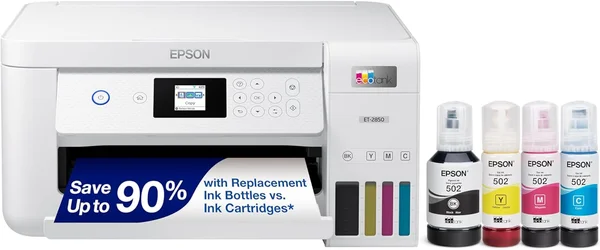
Under 20 decks a year on 170-200 gsm stock. Low running cost, no high upfront spend.
View on Amazon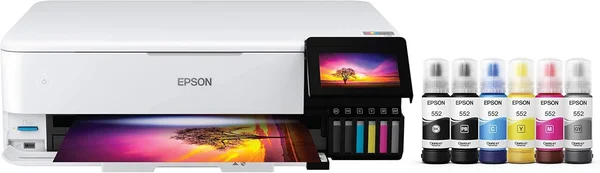
Better gamut and thicker-stock support, still tank-based, without the PRO-200's per-page running cost.
View on Amazon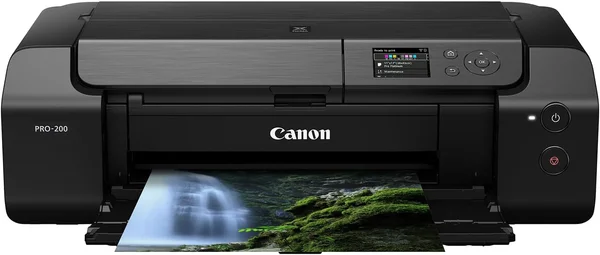
8-ink color, heavy stock to 300 gsm, A3+. The extra ink cost buys best-in-class card art.
View on AmazonFor most proxy printers, the ET-2850 is the right call. The PRO-200 earns its cost when card art quality is the deciding factor. It earns it visibly, at the table.